
From Static Models to Living Assets
How Digital Twins Are Becoming the Operational Risk Layer of Commercial Infrastructure
Executive Summary
For most of the modern era, a commercial building has been treated as a fixed quantity. Its risk was estimated once, recorded on a schedule of values, and revisited only when a policy renewed, a sale closed, or a visible failure forced attention. The asset itself was silent. Underwriters, lenders, and operators inferred its condition from age, construction class, occupancy, and the memory of the last inspection. That model held for as long as the built environment changed slowly and catastrophic losses remained statistically rare.
Neither condition still holds. Insured losses from natural catastrophes have exceeded one hundred billion dollars annually for several consecutive years (Swiss Re Institute, sigma 1/2025), driven less by singular mega-events than by an accumulation of secondary perils striking an aging, densely capitalized building stock. At the same time, the digital representation of physical assets has matured. The digital twin — once a marketing term for a three-dimensional model — has evolved into a continuously updated, data-fed analytical environment used to operate airports, energy systems, and manufacturing lines. The question this paper examines is why that evolution has, until recently, largely bypassed the structural condition of the buildings themselves.
The central argument is straightforward. A digital twin that models energy use, occupancy, and equipment performance but cannot describe how its structure is actually behaving is operationally incomplete. As digital twins become decision-making systems rather than visualization tools, that omission becomes material — to the operators who depend on continuity, and to the insurers who underwrite it.
Three forces are closing the gap. First, sensing has become cheap, wireless, and non-invasive, removing the cost barrier that once confined structural monitoring to landmark infrastructure. Second, artificial intelligence has shifted the value of monitoring from raw measurement to interpretation, allowing a small number of well-placed sensors to characterize a structure’s behavior rather than merely record it. Third, the economic logic of insurance and asset management has begun to reward continuous visibility.
The implication is a new category the series terms infrastructure intelligence: the continuous, AI-mediated translation of physical structural behavior into decision-ready risk information. Infrastructure is best understood not as a static asset whose risk is estimated but as a dynamic risk system whose state changes continuously and can now be observed.
None of this requires a wholesale replacement of existing practice. The most credible near-term path is integration: structural intelligence as a layer added to systems already in place, delivered through low-friction wireless deployment and subscription-based analytics. The organizations that move first are unlikely to do so through large capital programs. They will do it through targeted pilots that establish baselines, prove value on specific accounts or buildings, and expand as the evidence accumulates.
The Evolution of the Digital Twin
The term digital twin entered general use through aerospace and heavy manufacturing, where the cost of physical failure was high enough to justify maintaining a parallel virtual model of a critical asset. Early twins were essentially detailed simulations: a model of a jet engine or a turbine, calibrated against design specifications and used to predict behavior under defined conditions. Their value lay in answering the question of how an asset should behave.
The concept migrated into the built environment alongside the spread of Building Information Modeling. As construction projects began producing rich, structured digital models as a standard deliverable, those models offered an obvious foundation for an operational twin. A building delivered with a complete information model arrives with geometry, material specifications, and system layouts already described in machine-readable form. The natural next step was to keep that model alive after commissioning, feeding it data from the systems that operate the building.
This is where the first generation of building digital twins concentrated, and where most remain today. They are exceptionally good at the building’s metabolism: energy consumption, HVAC performance, occupancy patterns, lighting, water, vertical transportation, and the maintenance status of mechanical equipment. These systems are instrumented because they are operated continuously and because their performance maps directly to cost. A facilities team knows the runtime of every major chiller because that runtime appears on a utility bill.
A digital twin that knows everything about how a building consumes energy and nothing about how its structure is behaving is a portrait of metabolism without a skeleton.
The structure itself sits outside this loop. The frame, the foundations, the connections, and the load-bearing elements are typically represented in the twin exactly as they were modeled at design — as static geometry. They are not instrumented, because for decades there was no economically practical way to instrument them at scale, and because, unlike a chiller, a beam does not produce a monthly bill. The result is a curious asymmetry: the most consequential and least replaceable part of the building is the part the digital twin understands least.
This asymmetry was tolerable when digital twins were primarily visualization and reporting tools. It becomes a liability as they evolve into decision systems. The trajectory of the technology is unambiguous. Twins are increasingly used to automate responses, prioritize capital, trigger maintenance, and inform financial decisions. A decision system is only as sound as the completeness of its inputs. A twin that can optimize energy to the last percent but cannot tell its operator whether the building’s stiffness has changed after a seismic event is optimizing the wrong variable at the wrong moment.
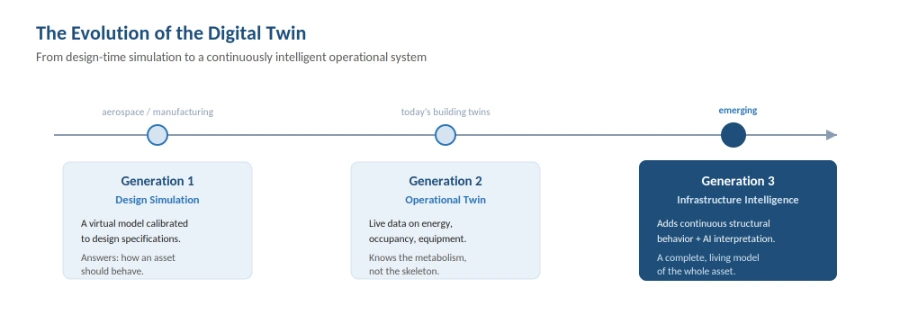
Figure 1. The digital twin’s three-generation arc — from design-time simulation, to today’s operational twin, to a structurally aware infrastructure intelligence system.
Operational Telemetry Versus Structural Intelligence
The distinction at the heart of this paper is between two kinds of data that are easily conflated. Operational telemetry describes how a building’s systems are performing. Structural intelligence describes how the building itself is behaving. The two are complementary, but they answer fundamentally different questions, and they degrade in fundamentally different ways.
Operational telemetry is abundant, well understood, and largely commoditized. A modern building management system generates a continuous stream of readings from thousands of points. This data is valuable, but it is also forgiving: a sensor that fails or a reading that drifts produces a localized, recoverable problem. The consequences of imperfect operational data are measured in comfort, efficiency, and routine maintenance.
Structural intelligence is scarce, historically expensive, and unforgiving in the opposite direction. The questions it answers are existential rather than operational: Has the building’s fundamental dynamic behavior changed? Did a loading event — an earthquake, a windstorm, an impact, a nearby excavation — leave the structure altered in a way invisible to the eye? Is a slow process of fatigue, settlement, or corrosion shifting the structure toward a threshold? These questions are rarely urgent until they are catastrophic, which is precisely why periodic inspection has proven an inadequate instrument for answering them. Recent events make the cost of that inadequacy concrete: the Morandi Bridge collapse in Genoa (2018), the Champlain Towers South collapse in Surfside, Florida (2021), and the Türkiye–Syria earthquake sequence (February 2023) each exposed structural conditions that periodic inspection failed to surface in time.
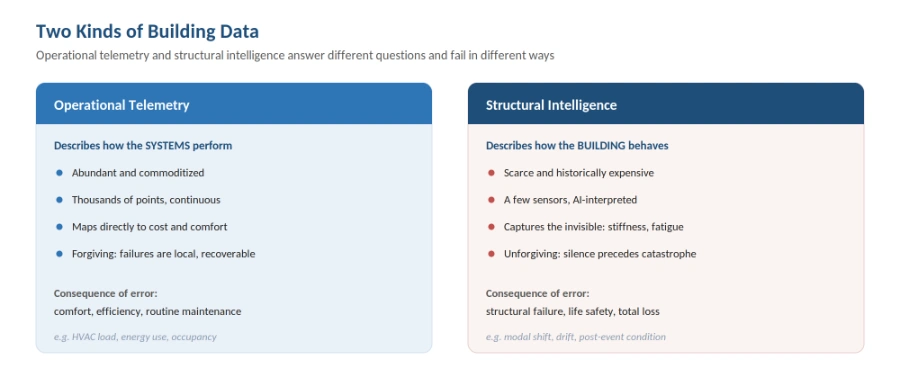
Figure 2. Operational telemetry and structural intelligence are complementary but distinct — differing in abundance, cost, what they can detect, and the severity of being wrong.
Why Periodic Inspection Cannot Close the Gap
Manual inspection remains the default mechanism for assessing structural condition, and it carries three structural limitations that no amount of inspector skill can overcome. The first is intermittency. An inspection is a snapshot taken at a single moment; it says nothing about what happens in the months or years between visits. A structure that experiences a significant loading event the week after an inspection carries that event silently until the next scheduled visit.
The second is visibility. Inspection assesses what can be seen. A great deal of structurally significant behavior is not visible: a change in a structure’s natural frequency that signals stiffness loss, plastic deformation within a connection that shows no surface cracking, or the gradual accumulation of fatigue damage in a member subject to cyclic loading. A building can pass a thorough visual inspection while harboring a meaningful change in its dynamic behavior.
The third is subjectivity. Two qualified inspectors can reach different conclusions about the same structure, because inspection translates observation into judgment, and judgment varies. This subjectivity is not a failure of professionalism; it is an inherent property of an assessment method that lacks a continuous, quantitative baseline against which to measure change.
Structural intelligence addresses all three limitations not by replacing the inspector but by changing what the inspector and the underwriter have to work with. Continuous sensing eliminates intermittency. Measurement of dynamic behavior captures what is invisible to the eye. A quantitative, continuously updated baseline replaces subjective judgment with measured change. The inspector still matters — but now arrives informed, directed to the specific zones where measured behavior has shifted, rather than conducting a blanket survey in search of the visible.
Infrastructure as a Dynamic Risk System
The conceptual shift this series advances is from infrastructure-as-asset to infrastructure-as-system. An asset is something whose value is recorded and whose risk is estimated. A system is something whose state changes continuously and can be observed. The difference is not semantic. It changes what is possible to know, and therefore what is possible to manage and to price.
Consider how a structure’s risk profile actually behaves over time. It is not a flat line punctuated by sudden failures. It is a continuously varying signal shaped by loading history, environmental exposure, material aging, occupancy changes, and discrete events. A building’s true structural risk on any given day is a function of everything that has happened to it. The traditional model collapses this rich, time-varying signal into a handful of static descriptors recorded at policy inception and treated as constant until renewal.
The dynamic-system view treats the building’s condition as a state that evolves and can be tracked. This reframing has direct consequences for every party with exposure to the asset. For the operator, it converts maintenance from a calendar-driven activity into a condition-driven one. For the lender, it offers a continuously updated read on collateral. For the insurer, it transforms the fundamental information problem of underwriting — the gap between what is knowable about a risk at the moment of pricing and what is true about it over the life of the policy.
The Information Asymmetry at the Core of Property Risk
Commercial property underwriting has always operated under a severe information constraint. The underwriter prices a risk at a single moment using a small set of static attributes, then carries that risk forward, often for years, with little visibility into how the underlying condition changes. The premium reflects the building as it was understood at inception, not as it actually exists at any subsequent point.
This asymmetry produces predictable inefficiencies. Resilient, well-maintained buildings subsidize deteriorating ones, because both are priced from the same coarse classification. Losses that early intervention could have prevented proceed to claims because no signal reached anyone in time to act. Post-event uncertainty drives conservative, costly decisions — prolonged closures, repeated inspections, disputed causation — because no objective record exists of what the building experienced and how it responded.
The cost of being wrong about a structure has risen faster than the cost of continuously watching it. That inversion is what makes infrastructure intelligence economically inevitable rather than merely possible.
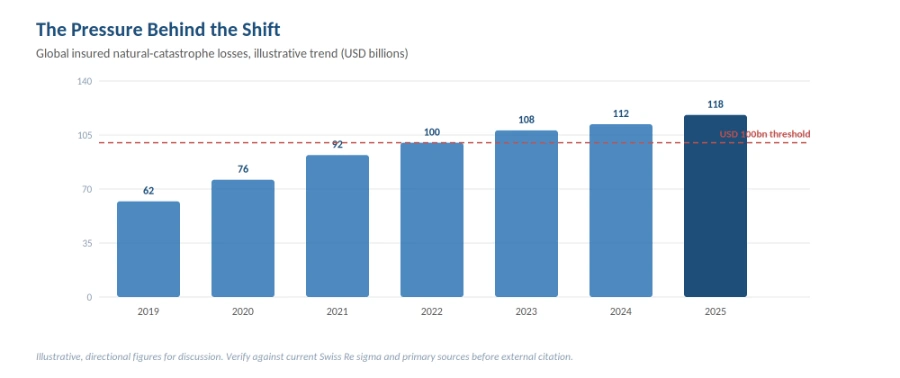
Figure 3. Sustained, rising catastrophe losses are the macro pressure behind the shift.
Continuous structural intelligence attacks this asymmetry at its source. It does not eliminate uncertainty, but it narrows the gap between what is knowable and what is true, and it does so continuously rather than at discrete intervals. The economic value created is the value of acting on information sooner: pricing that reflects actual condition, intervention that precedes failure, and post-event decisions grounded in measured response rather than inference.
Artificial Intelligence and Infrastructure Cognition
The single most important enabler of this transition is not the sensor. It is the analytical layer that sits between raw measurement and decision. Without it, structural monitoring produces an overwhelming volume of time-series data that demands expert interpretation — the very expertise it was meant to scale. The role of artificial intelligence is to convert raw structural response into condition intelligence, and in doing so to change the economics of monitoring entirely.
The technical foundation is the relationship between a structure’s physical condition and its dynamic behavior. Every structure has a characteristic way of vibrating, defined by its natural frequencies, mode shapes, and damping. These modal properties are a function of the structure’s mass and stiffness. When a structure is damaged or deteriorates — when a connection loosens, a member cracks, a foundation settles — its stiffness changes, and its modal properties shift accordingly. A statistically significant change in a structure’s natural frequencies is among the earliest measurable indicators of stiffness loss, and stiffness loss is the physical signature of structural degradation.
From Dense Instrumentation to Inferential Modeling
Historically, characterizing a structure’s modal behavior in detail required many sensors distributed across the structure to map its mode shapes directly. This is the model that made structural monitoring prohibitively expensive: hundreds of sensors, extensive wiring, dedicated data acquisition infrastructure, and specialized engineering teams. It was justifiable for a landmark bridge and impossible for an ordinary office tower.
The advance that breaks this constraint is inferential. AI-assisted methods use the relationship between acceleration signals at a small number of strategic locations — typically near the base, mid-height, and roof of a structure — to infer global structural behavior with high confidence, rather than mapping it exhaustively. The underlying techniques combine operational modal analysis, Bayesian model updating, and physics-informed anomaly detection — established methods that have moved from research environments into production use as compute, communications, and sensor costs have fallen. A model of the structure, continuously tuned by live measurements, can estimate behavior at locations where no sensor is physically installed. The intelligence migrates from the density of the sensor array to the sophistication of the model interpreting it.
The practical effect is dramatic. A structure that once required dozens of sensors to monitor can now be meaningfully characterized by a handful — in many commercial applications, on the order of three to five units per building (a configuration validated in StructureIQ’s commercial Sentinel AI deployments). This is not a marginal cost improvement. It is the difference between a technology confined to flagship assets and one deployable across an entire portfolio. AI does not merely improve structural monitoring; it removes the principal barrier that kept it from scaling.
Edge Processing and the Filtering of Noise
A second contribution of the analytical layer is the separation of signal from noise at or near the point of measurement. A structure is constantly in motion — wind, traffic, foot traffic, machinery, and ordinary occupancy all produce vibration. The overwhelming majority of this motion is structurally irrelevant. A monitoring system that escalated every detectable movement would be useless, generating exactly the alert fatigue that has made operators wary of on-site instrumentation.
Edge processing addresses this by performing classification close to the sensor, distinguishing genuine structural response from ambient noise and transmitting decision-relevant information rather than raw waveforms. Machine learning models trained on structural behavior separate the meaningful from the routine: a seismic response from a passing truck, a genuine anomaly from a temperature-induced drift. This filtering serves two purposes simultaneously. It reduces the bandwidth and storage cost of monitoring, and — more importantly — it ensures that what reaches a human is a considered signal rather than a torrent of data. The system is designed to deliver insight, not telemetry.
Decision-ready intelligence is more valuable than raw telemetry. The defining feature of a credible infrastructure intelligence system is what it chooses not to send.
Digital Twin Architectures for Structural Intelligence
Bringing structural intelligence into the digital twin requires a coherent architecture, and the most credible architectures share a common shape. They are layered, wireless at the edge, AI-mediated in the middle, and integration-oriented at the top. Each layer is chosen to minimize friction and maximize compatibility with systems already in place.
At the sensing layer, the preference is decisively for wireless, non-invasive instrumentation. Battery-powered sensors communicating over cellular or low-power wide-area networks eliminate the wiring, conduit, and data acquisition infrastructure that made traditional monitoring invasive and expensive. Non-invasive mounting allows installation in hours rather than days, without penetrating building envelopes or disrupting tenants. This is not a minor convenience. Retrofit-friendly deployment is what makes the existing building stock — the overwhelming majority of which will never be rebuilt — addressable at all.
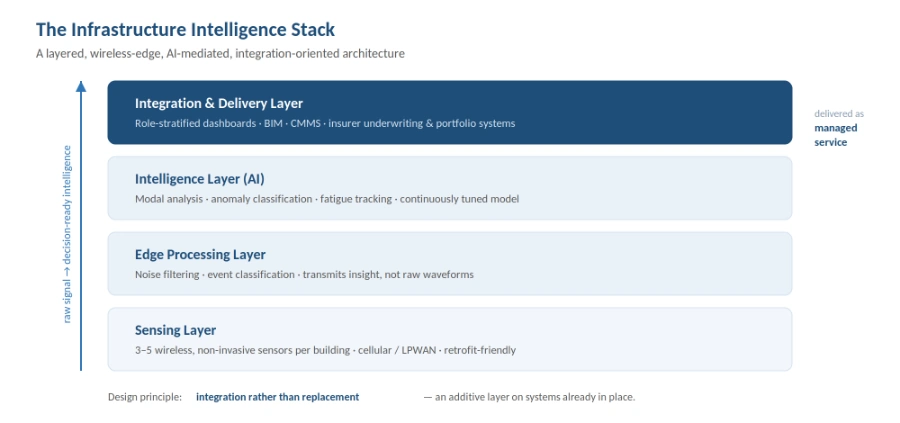
Figure 4. The infrastructure intelligence stack: a few wireless sensors at the edge, AI interpretation in the middle, and integration with existing enterprise and insurer systems at the top — delivered as a managed service.
At the intelligence layer sits the analytical engine described above: preprocessing and noise filtering, modal analysis to track dynamic behavior, anomaly detection to classify events, and a continuously tuned model that extends understanding beyond the physical sensor locations. This layer is where the system earns its name. A monitoring product transmits data; an intelligence platform interprets it.
At the integration layer, the architecture connects outward rather than standing alone. The defining principle is integration rather than replacement. Structural intelligence is most valuable as an additive layer that feeds existing environments — building information models, asset and maintenance management systems, enterprise analytics, and, critically, insurer underwriting and portfolio platforms. Interoperability with established information standards allows live structural data to populate the digital twin rather than forming a parallel silo that demands manual reconciliation.
The Managed-Service Model
The commercial structure that fits this architecture is the managed service. Rather than a capital purchase of hardware and software, infrastructure intelligence is most naturally delivered as a subscription: sensing, analytics, dashboards, and reporting provided as an ongoing operational service. This aligns cost with benefit, converts a capital decision into an operating one, and — decisively for adoption — allows an organization to begin small and expand as value is demonstrated.
The dashboard that delivers this service is necessarily role-stratified. The structural engineer needs access to underlying analytics. The asset manager needs condition trends and alerts. Operations and risk leadership need health summaries and portfolio views. An insurer needs underwriting-relevant indicators and portfolio benchmarks. The same continuous data stream serves all of them, presented at the level of abstraction each requires. This is the operational meaning of decision-ready intelligence: the right signal, to the right person, in the form they can act on.
Toward a Structural Risk Score
The most consequential output of an infrastructure intelligence system is also the most intuitive: a continuous, normalized score expressing a structure’s condition. The various analytical processes — modal analysis, fatigue tracking, anomaly classification, trend analysis — converge on a single question that every stakeholder asks in some form: how is this structure doing, and is it getting better or worse?
A structural condition score answers that question quantitatively. Expressed on a normalized scale and tiered into intuitive bands — healthy, watch, at risk — it compresses a complex analytical picture into a form that a non-engineer can act on while preserving the underlying detail for those who need it. Paired with probabilistic measures that express the likelihood of damage at given future loading levels, it becomes forward-looking rather than merely descriptive: not only how the structure is now, but how it is likely to respond to what comes next.
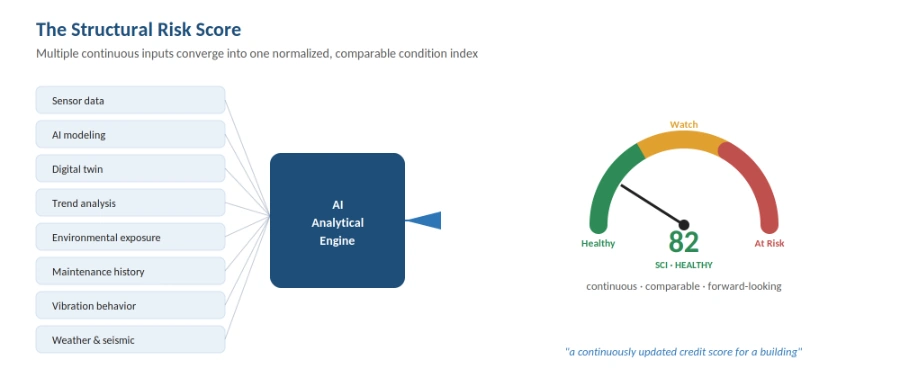
Figure 5. The structural risk score consolidates diverse continuous inputs into a single normalized, comparable index — the functional equivalent of a continuously updated credit score for a building.
A continuously updated structural score functions, in practice, as the equivalent of a credit score for a building — a single comparable indicator standing in for an expensive, intermittent, and subjective assessment.
The analogy to a credit score is worth drawing deliberately, because it is intuitive for exactly the audiences who will decide whether this technology matters: insurers, executives, investors, and portfolio operators. A credit score does not capture every nuance of a borrower’s finances, but it provides a continuously updated, comparable, and actionable summary that transformed lending from a relationship-based art into a scalable discipline. A structural condition score offers a structurally similar proposition for the built environment: a quantitative, comparable, continuously updated substitute for assessment that was previously qualitative, incomparable across assets, and refreshed only sporadically.
The power of such a score lies in its comparability. A score that means the same thing across a high-rise, a warehouse, and an industrial facility enables something the built environment has never had: portfolio-level structural condition management. An insurer or owner with hundreds of assets can rank them by condition, direct attention to the elevated-risk minority, and benchmark across the portfolio. This is the bridge from monitoring a single building to managing infrastructure risk at scale.
Smart Cities and Intelligent Infrastructure
The same architecture that makes a single building intelligent scales naturally to the urban level, and the public stakes are higher. The aging of public infrastructure is well documented: a substantial share of bridges in developed economies are classified as structurally deficient, and the average age of that infrastructure continues to climb (ASCE 2025 Infrastructure Report Card; FHWA National Bridge Inventory). Buildings face an analogous challenge, particularly the large stock constructed before modern seismic and resilience codes. The monitoring deficit is not a niche engineering problem; it is a systemic gap in the visibility societies have into the structures their daily functioning depends on.
The post-disaster case is the most vivid. After a major earthquake, the binding constraint on recovery is often not repair capacity but assessment capacity. Engineers must manually evaluate potentially thousands of buildings to determine which are safe to occupy, a process that has historically taken weeks during which displaced occupants cannot return and undamaged buildings sit needlessly empty. A network of AI-enabled sensors across even a fraction of a city’s building stock could compress that timeline from weeks to hours, allowing buildings that measured response shows to be sound to be cleared quickly and directing scarce engineering attention to those that genuinely need it.
This is where infrastructure intelligence intersects with public resilience policy. As the integration of monitoring with building information environments becomes standard, and as insurers and lenders begin to treat structural data as a valued input, a financial incentive structure emerges that may drive adoption faster than regulation alone. Some jurisdictions in high-seismicity regions are beginning to discuss monitoring requirements for certain building categories, which would accelerate the transition further. The direction is consistent across these drivers: toward a built environment that is observed continuously rather than inspected occasionally.
Insurance Implications
For the commercial property insurance industry, the maturation of infrastructure intelligence is not a peripheral technology development. It addresses the industry’s central information problem and opens a set of capabilities that map directly onto its most persistent pain points.
The first and most direct implication is for underwriting. Continuous structural data converts pricing from an exercise grounded in static classification into one informed by measured condition. Buildings that demonstrate resilience through their actual behavior can be distinguished from superficially similar structures showing concerning trends. This precision allows insurers to compete for genuinely better risks while maintaining pricing discipline on those that warrant it — a combination that improves both growth and loss ratios. Even modest improvements in loss ratio translate into substantial bottom-line effect given typical commercial property margins. By way of illustration, a one-percentage-point reduction in loss ratio on a $500 million commercial property book translates to roughly $5 million of underwriting margin before reinsurance and reserve effects — a return that justifies meaningful investment in the information that produces it.
The second implication is for claims and business interruption. Following a catastrophic event, the question of whether a building is safe to occupy drives enormous cost. Buildings are frequently closed pending manual inspection that can take weeks given the shortage of available engineers, and business interruption losses often exceed physical damage (Lloyd’s of London, City Risk and Resilience research). A structure equipped with continuous monitoring can provide objective, near-immediate evidence of how it responded to an event, enabling rapid and defensible occupancy decisions. The same time-stamped record reduces disputes over causation and timing, lowering loss adjustment expense and accelerating settlement.
In practice: IKEA Mexico City. StructureIQ’s continuous monitoring deployment at IKEA’s Mexico City retail asset — one of the most seismically active major urban environments in the world — illustrates the mechanism in operation. The platform establishes a measured behavioral baseline at installation, observes the asset continuously, and produces objective post-seismic structural reads within hours of an event, supporting rapid occupancy decisions and replacing the multi-day re-inspection process that conventional practice requires. For a high-turnover retail asset where every day of closure carries direct loss-of-use cost, the value created is not theoretical; it is measured in days of trading recovered and in defensible documentation for the insurer of record.
The third implication is the emergence of new products. Continuous, verifiable structural data is the enabling condition for parametric coverage triggered by measured response, for maintenance-linked products that reward good stewardship, and for dynamic pricing that reflects condition over the policy term rather than fixing it at inception. These products are not feasible without an objective, continuous data source. Infrastructure intelligence supplies exactly that, and in doing so makes a new product category possible rather than merely improving an existing one.
Taken together, these implications point toward a broader conclusion that the series will substantiate: continuous structural data is positioned to become a recognized input category for commercial property underwriting, much as telematics became an input for automobile insurance. The mechanism differs, but the logic is identical — a continuous, objective signal about an insured asset displaces inference from static proxies, and the insurers who incorporate it first capture the advantage of pricing and selecting on information their competitors cannot see.
Regulatory and Standards Drivers
Adoption of infrastructure intelligence is reinforced by an evolving landscape of standards and regulatory expectation. These frameworks are most useful here not as compliance obligations but as evidence that the institutions responsible for structural reliability, asset management, and risk are converging on the principles that continuous monitoring enables.
The international standards governing structural reliability and the assessment of existing structures establish the principle that an asset’s reliability should be quantified and tracked across its lifecycle, and that the evaluation of existing structures should move toward condition-based assessment rather than relying solely on periodic visual inspection. Continuous monitoring is a direct mechanism for satisfying that principle. Standards for asset management and for risk management similarly emphasize data-driven, lifecycle-oriented decision-making — again, precisely what continuous structural data supports. Information-management standards that govern building information modeling provide the interoperability foundation that allows live structural data to integrate with the digital twin rather than existing apart from it.
The regulatory trajectory points in the same direction. Resilience has moved from an engineering concern to a financial and governance one, surfacing in investor expectations, lender requirements, and emerging disclosure regimes. Reporting on physical asset resilience increasingly demands measured evidence rather than assertion. An organization that can demonstrate continuous structural monitoring and condition-based maintenance holds verifiable, auditable data of exactly the kind these regimes are beginning to require. The standards and the regulation are not the cause of the transition, but they are steadily removing the reasons not to make it.
Near-Term Adoption
The practical path to adoption is incremental, and this is a feature rather than a limitation. The economics of modern monitoring — low sensor counts, wireless deployment, rapid installation, and subscription delivery — make it possible to begin without significant capital commitment or organizational disruption. The credible entry point is the targeted pilot rather than the portfolio-wide program.
A well-designed pilot selects a modest set of buildings that represent meaningful risk or strategic value: assets in high-hazard zones, aging structures with known vulnerabilities, high-value accounts that justify additional attention, or new construction where establishing a performance baseline informs future decisions. It defines success criteria in advance — the accuracy of condition assessment against engineering judgment, the time saved in post-event evaluation, the refinement of pricing for monitored assets — and it runs long enough to establish behavioral baselines and ideally to capture at least minor loading events that test the system under real conditions.
The deployment itself establishes something valuable independent of any future event: an objective structural baseline. A monitoring system installed today creates the measured reference against which all future change is assessed. This baseline has standalone value as engineering and legal documentation, and it is particularly significant in dense urban environments where adjacent construction can affect neighboring structures and where defensible before-and-after evidence is increasingly demanded. The act of beginning to measure is itself the creation of an asset.
The organizations positioned to lead are those that treat early deployment as learning rather than procurement. The first pilots establish not only technical proof but organizational fluency: underwriters, risk engineers, claims staff, and asset managers develop the working knowledge of how structural intelligence integrates into their decisions. That fluency, accumulated early, is itself a durable competitive advantage when the technology becomes standard.
Mid-Term Evolution
Looking beyond initial adoption, the trajectory points toward infrastructure intelligence becoming a foundational operational layer rather than a discrete product. As analytical capability advances, sparse sensor networks will diagnose not merely the presence of damage but its probable cause, location, severity, and trajectory — enabling the kind of predictive maintenance long standard in aerospace and industrial manufacturing but rarely achieved in civil infrastructure at scale.
As the installed base grows, the value of cross-asset data compounds. A single monitored building yields insight about itself. A portfolio of monitored buildings yields insight about how classes of structures behave, how they age, and how they respond to events — a body of empirical knowledge that improves the models applied to every asset, including those not yet monitored. This is the trajectory by which infrastructure intelligence shifts from a tool that observes individual buildings to a system that informs the understanding of the built environment as a whole.
The endpoint this series envisions is one in which continuous structural condition is simply part of how commercial infrastructure is operated, financed, and insured — as routine as the operational telemetry that today’s digital twins already capture. The structure ceases to be the silent, unobserved core of an otherwise instrumented building. It becomes a communicating element of a system that knows its own state. The digital twin, completed by structural intelligence, becomes what its name has always implied: a faithful, living representation of the asset, including the part that matters most.
Conclusion
The digital twin has spent its first decade in the built environment becoming extraordinarily good at understanding how buildings consume, operate, and perform — and almost entirely blind to how they structurally behave. That blindness was a function of cost, not indifference. Instrumenting a structure at scale was, until recently, impractical. Three converging advances — inexpensive wireless sensing, AI-enabled inferential analysis that extracts global behavior from a handful of measurements, and a commercial model that delivers all of it as a low-friction service — have removed that barrier.
The consequence is the emergence of infrastructure intelligence: the continuous translation of physical structural behavior into decision-ready risk information. It completes the digital twin by giving it awareness of its own skeleton. It reframes infrastructure from a static asset whose risk is estimated into a dynamic system whose condition is observed. And it offers every party with exposure to the built environment — operators, lenders, insurers, and the public — a path out of the information asymmetry that has constrained structural risk management since its inception.
For the commercial property insurance market specifically, the implications are foundational rather than incremental. Continuous structural data attacks the industry’s central information problem, sharpens underwriting, accelerates and de-risks claims, and enables an entirely new category of products. The structural condition score — the credit score for a building — offers a comparable, continuously updated, portfolio-scale measure of an asset class that has never had one.
The transition is not speculative; it is underway. The remaining papers in this series examine its two most consequential dimensions in depth: the continuous structural intelligence and predictive analytics that make it work, and the insurance and resilience economics that make it matter. The strategic question facing every insurer, operator, and integrator is not whether continuously intelligent infrastructure becomes a foundational layer of commercial property operations and insurance. It is how soon, and on whose terms.
Summary: Two Models of Structural Knowledge
The shift from periodic assessment to continuous intelligence can be summarized across the dimensions that matter most to operators and insurers.
| Dimension | Periodic Inspection Model | Infrastructure Intelligence Model |
| Timing | Snapshot at intervals of months or years | Continuous, 24/7 observation |
| Basis | What is visible to the eye | Measured dynamic behavior, including the invisible |
| Output | Subjective pass / fail judgment | Continuous normalized condition score with risk bands |
| Post-event | Engineer mobilization; days to weeks | Objective condition read within hours |
| Baseline | Static design assumptions | Continuously tuned as-built model |
| Scalability | Per-building, labor-bound | Portfolio-wide, comparable across asset types |
| Cost barrier | High where comprehensive; otherwise infrequent | Low: few wireless sensors, subscription delivery |
About StructureIQ
StructureIQ is an Illinois-based AI-driven structural health monitoring company. Its Sentinel AI platform combines wireless Xnode IoT sensors, a secure gateway, an AI analytics engine, and a role-stratified customer dashboard to produce a continuously updated Structural Condition Index — a single 0–100 score per asset that reflects measured structural behavior, updated continuously across the asset’s life. The platform is multi-peril by design: one sensor stack reads vibration, drift, tilt, and anchor tension across seismic, wind, flood, fire, aging, and impact regimes; only the alerting envelope changes.
Validated production deployments include IKEA Mexico City (seismic monitoring, with a global insurer-engineering reference), the Jindo Bridge (wind and traffic monitoring), the Ain Dubai observation wheel (operational tension monitoring), and a Class I rail bridge (impact monitoring). The underlying technology rests on three issued US patents and an exclusive UIUC field license through March 2032.
For inquiries about the Infrastructure Intelligence Series or about deployment, integration, and underwriting applications of Sentinel AI, contact: info@structureiq.ai.
References and Source Frameworks
This paper draws on publicly available research, industry analysis, and international standards. Representative sources include:
- Swiss Re Institute. sigma research on natural catastrophe insured losses. Zurich: Swiss Re.
- Federal Emergency Management Agency (FEMA). Building Codes Save: A Nationwide Study on Hazard-Resistant Building Codes. Washington, D.C.
- American Society of Civil Engineers (ASCE). Infrastructure Report Card and bridge condition assessments.
- McKinsey & Company. Analysis on the future of artificial intelligence in the insurance industry.
- Deloitte Insights. Analysis on scaling generative AI and data-driven risk assessment in insurance.
- Spencer, B. F., Jr., et al. Research on wireless smart sensors and distributed structural health monitoring, Smart Structures Technology Laboratory, University of Illinois at Urbana-Champaign.
- Peer-reviewed research published in Sensors (MDPI) on high-sensitivity wireless accelerometers, edge-based structural health monitoring, and digital twins for civil infrastructure.
- Lloyd’s of London. Analysis on the role of IoT and AI in urban resilience and city risk.
- ISO 2394 (reliability of structures), ISO 13822 (assessment of existing structures), ISO 55000 (asset management), ISO 19650 (BIM and information management), and ISO 31000 (risk management).
Sources are referenced to establish context and direction. Specific figures should be verified against the most recent primary publications before external citation.