
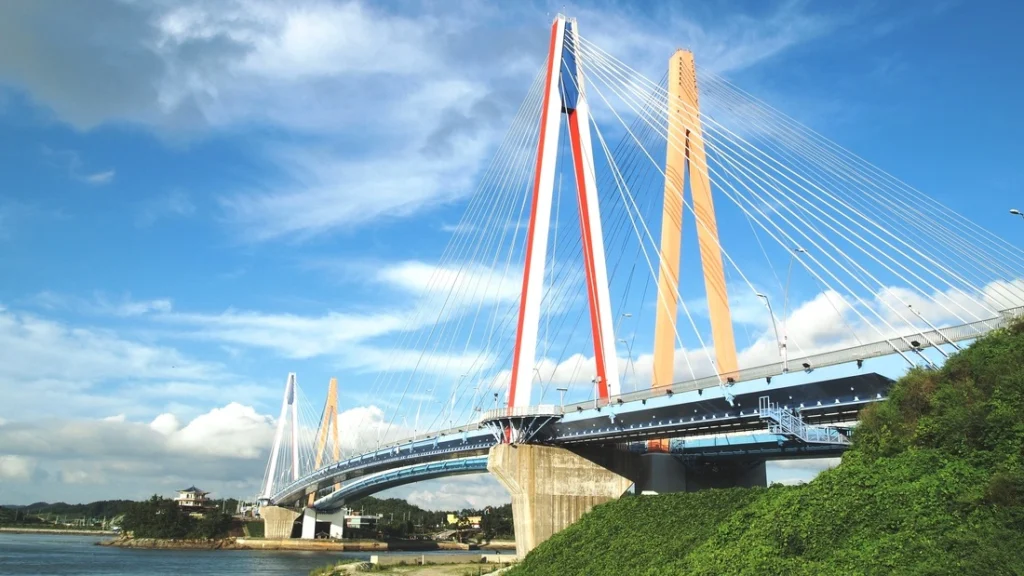
One of the Largest Wireless Smart Sensor Networks for Civil Infrastructure Monitoring
Bridge Monitoring Case Study – Jindo Bridge, South Korea
The structural monitoring of the Jindo Bridge in South Korea was a collaboration between the University of Illinois and a university in Korea to demonstrate the viability of wireless sensing. When installed, it was one of the largest wireless structural health monitoring (SHM) deployments undertaken, featuring over 100 sensors that provided more than 600 sensor channels of near real-time data. The outcome was the development of the foundational sensor network and IoT software, which forms the core of the IoT part of StructureIQ’s solution.
- Location: Jindo Bridges, South Korea
- Collaborating Institutions: University of Illinois Urbana-Champaign (USA), KAIST (Korea), University of Tokyo (Japan)
- Lead Researcher (U.S.): Dr. Hongki Jo, University of Illinois Urbana-Champaign; Advisors: Prof. B.F. Spencer Jr. and Prof. G. Agha
- Deployment Period: 2009 – 2012
- Technology Platform: Smart Sensor Network (Wireless Structural Health Monitoring System)
The Problem
Traditional wired structural monitoring systems for bridges and other large infrastructure are expensive and complex to install. They require kilometers of wiring for power and data, making routine maintenance and inspection costly and often reactive. Bridge owners and engineers need a cost-effective, scalable, and reliable method for continuous, proactive monitoring of structural health.
The Solution: The Jindo Bridge Wireless Monitoring Network
The solution is a wireless sensor network designed for continuous monitoring of structural health. This system uses small, low-power electronic sensors and microprocessors to track key structural factors such as vibration, wind conditions and humidity. Powered by solar energy, the monitoring network also reduces wiring and complexity.
How It Works
- Deployment: A network of wireless sensors is strategically placed on the structure.
- Data Collection: The sensors continuously monitor the structure and gather real-time data.
- Analysis & Reporting: The network evaluates the data and promptly reports anomalies or potential issues to engineers.
- Power Efficiency: The system features advanced power-management software. Sensors can extend battery life by harvesting energy from the sun, supporting long-term, low-maintenance operation.
Wireless vs. Traditional Wired Monitoring
- Installation Cost: Wireless is significantly lower, versus thousands of dollars per channel for wired systems.
- Maintenance: Wireless maintenance is low, with batteries expected to last three years, versus high maintenance requirements for extensive wiring in wired systems.
- Scalability/Deployment: Wireless deployment is simple and fast with no extensive wiring infrastructure required, versus complex and time-consuming wired installs.
- Power Source: Wireless systems are flexible, with power harvesting from sun, wind, or vibration, versus wired systems that require running power wires.
- Value Proposition: Wireless enables proactive, data-driven decisions for bridge owners as a potential alternative to manual inspection, while wired systems are typically used for reactive, event-driven monitoring.
Technology
The project required seven core developments focused on hardware, for multi-metric sensing and power harvesting, and software, for autonomous, power-efficient, fault-tolerant operation, cable tension monitoring, and user management of the Imote2 wireless smart sensor network (WSSN).
Market Opportunity
StructureIQ is a data-driven solution that improves global infrastructure safety, resilience, and financial stability. The company’s wireless monitoring systems provide an affordable and practical alternative to traditional wired systems for long-span bridges, buildings, and other structures. The technology is especially useful after major events, like earthquakes, to quickly verify if there is any damage to a structure, leading to cost savings and enhanced safety for infrastructure owners.
StructureIQ builds on the success of pioneering wireless sensor networks, such as the Jindo Bridge system, to fundamentally transform the Structural Health Monitoring (SHM) industry. By utilizing a patented, low-cost smart sensor technology combined with advanced Internet of Things (IoT) and AI-powered analytics offered through a scalable SaaS subscription, StructureIQ delivers continuous, real-time intelligence that benefits key industry stakeholders:
- Owners: Reduces costs and extends asset lifespan through continuous monitoring.
- Engineers: Provides immediate, actionable data and automated alerts for quick post-event safety decisions.
- Insurers: Delivers precise, objective data for more accurate risk assessment and pricing.
Download the full case study PDF
Contact StructureIQ to learn more: info@structureiq.ai