

Articles & Scientific Papers
Transforming Commercial Property Insurance with AI-Enabled Structural Health Monitoring

The commercial property insurance industry is facing unsustainable financial risks due to outdated, sporadic inspection models and increasing natural disasters, necessitating a shift to next-generation Structural Health Monitoring (SHM). Unlike subjective manual or drone inspections, SHM utilizes AI-enabled wireless sensors to create a “digital twin” that provides 24/7, real-time data on a building’s internal structural integrity. This transition to objective, continuous monitoring enables a proactive approach that reduces loss ratios, minimizes business interruption, and optimizes premiums by detecting damage before it becomes catastrophic.
The Future of Commercial Property Underwriting: How AI-Powered Structural Health Monitoring is Reshaping Risk Assessment

Commercial property insurance underwriting is facing growing challenges from aging infrastructure, rising catastrophe losses, and the limitations of traditional, inspection-based risk assessment. This article examines how AI-powered Structural Health Monitoring (SHM), enabled by affordable wireless sensor networks and cloud-based analytics, is transforming underwriting from a retrospective, assumption-driven process into a continuous, data-driven discipline. By providing real-time visibility into structural performance, SHM delivers actionable risk intelligence that improves pricing accuracy, loss ratios, claims efficiency, and customer engagement. The article explores the economic feasibility of modern SHM through subscription-based models, its integration into underwriting and claims workflows, and the competitive advantages it offers insurers willing to adopt early. It concludes that continuous structural monitoring is poised to become a foundational capability in commercial property insurance, reshaping how risk is assessed, managed, and priced.
Structural health monitoring of a cable-stayed bridge using smart sensor technology: deployment and evaluation
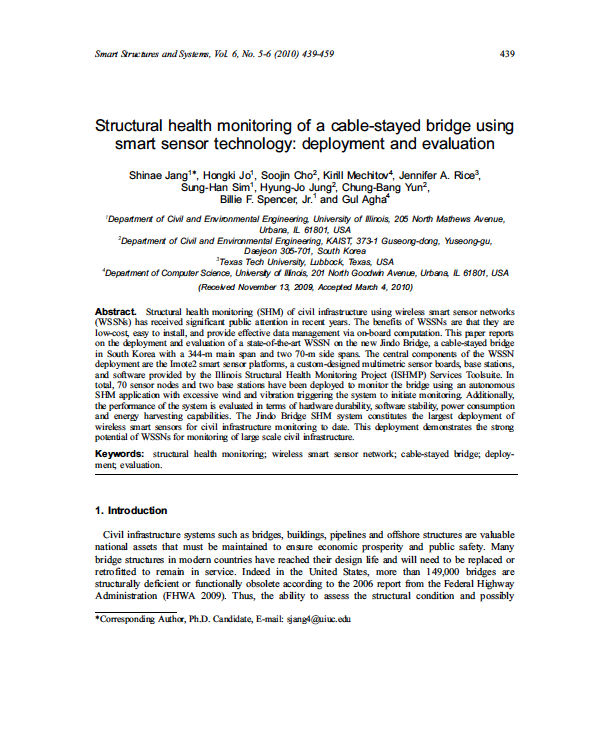
Structural health monitoring (SHM) of civil infrastructure using wireless smart sensor networks
(WSSNs) has received significant public attention in recent years. The benefits of WSSNs are that they are
low-cost, easy to install, and provide effective data management via on-board computation. This paper reports
on the deployment and evaluation of a state-of-the-art WSSN on the new Jindo Bridge, a cable-stayed bridge
in South Korea with a 344-m main span and two 70-m side spans. The central components of the WSSN
deployment are the Imote2 smart sensor platforms, a custom-designed multimetric sensor boards, base stations,
and software provided by the Illinois Structural Health Monitoring Project (ISHMP) Services Toolsuite. In
total, 70 sensor nodes and two base stations have been deployed to monitor the bridge using an autonomous
SHM application with excessive wind and vibration triggering the system to initiate monitoring. Additionally,
the performance of the system is evaluated in terms of hardware durability, software stability, power consumption
and energy harvesting capabilities. The Jindo Bridge SHM system constitutes the largest deployment of
wireless smart sensors for civil infrastructure monitoring to date. This deployment demonstrates the strong
potential of WSSNs for monitoring of large scale civil infrastructure.
Modeling and analyzing real-time wireless sensor and actuator
networks using actors and model checking
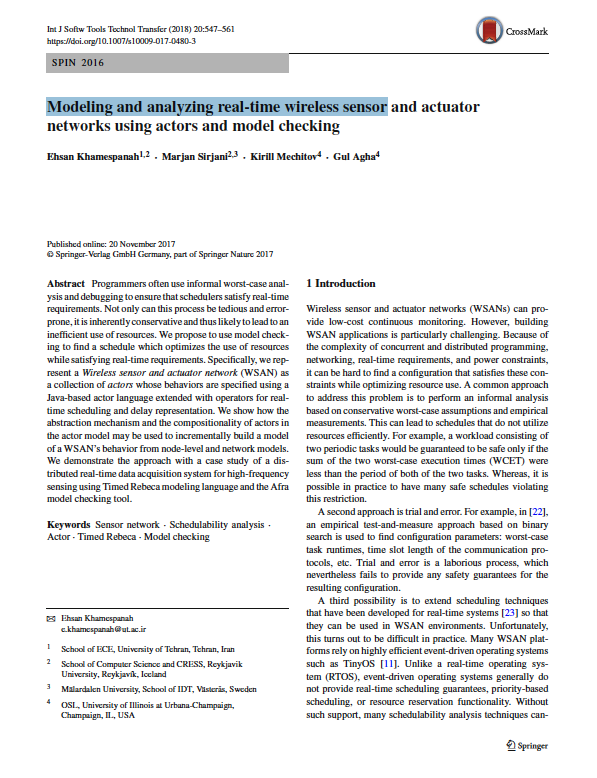
Programmers often use informal worst-case analysis and debugging to ensure that schedulers satisfy real-time requirements. Not only can this process be tedious and error-prone, but it is also inherently conservative, likely leading to inefficient resource use.We propose to use model checking to find a schedule that optimizes the use of resources
while satisfying real-time requirements. Specifically, we represent a Wireless sensor and actuator network (WSAN) as
a collection of actors whose behaviors are specified using a Java-based actor language extended with operators for real-time
scheduling and delay representation. We show how the abstraction mechanism and the compositionality of actors in
the actor model may be used to incrementally build a model of a WSAN’s behavior from node-level and network models.
We demonstrate the approach with a case study of a distributed real-time data acquisition system for high-frequency
sensing using TimedRebeca modeling language and the Afra model checking tool.
Development of a High-SensitivityWireless Accelerometer for Structural Health Monitoring

Structural health monitoring (SHM) is becoming increasingly vital for ensuring the safety of structures. A shift in SHM research from traditional wired methods toward wireless smart sensors (WSS) has been driven by the appealing features of wireless smart sensor networks (WSSN). Advances in Micro Electro-Mechanical System (MEMS) technologies and wireless data transmission have expanded the effectiveness and scope of WSSNs. One of the most common sensors used in SHM strategies is the accelerometer; however, most accelerometers in WSS nodes lack sufficient resolution for measuring the typical accelerations encountered in many SHM applications. In this study, a high-resolution, low-noise tri-axial digital MEMS accelerometer is integrated into a next-generation WSS platform, the Xnode. Besides addressing the acceleration sensing needs of large-scale civil infrastructure, this new WSS node offers powerful hardware and a robust software framework to enable edge computing capable of delivering actionable insights. Hardware and software integration challenges are outlined, and their solutions discussed. The performance of the wireless accelerometer is demonstrated experimentally through comparison with high-sensitivity wired accelerometers. This new high-sensitivity wireless accelerometer will extend the use of WSSN to a broader class of SHM applications.